
In the fight against fraud, we have long sought strong evidence. An official document. A correct password. A known device. Strong authentication. But in today’s digital economy, this strong evidence has become easy to imitate… because it is often exposed.
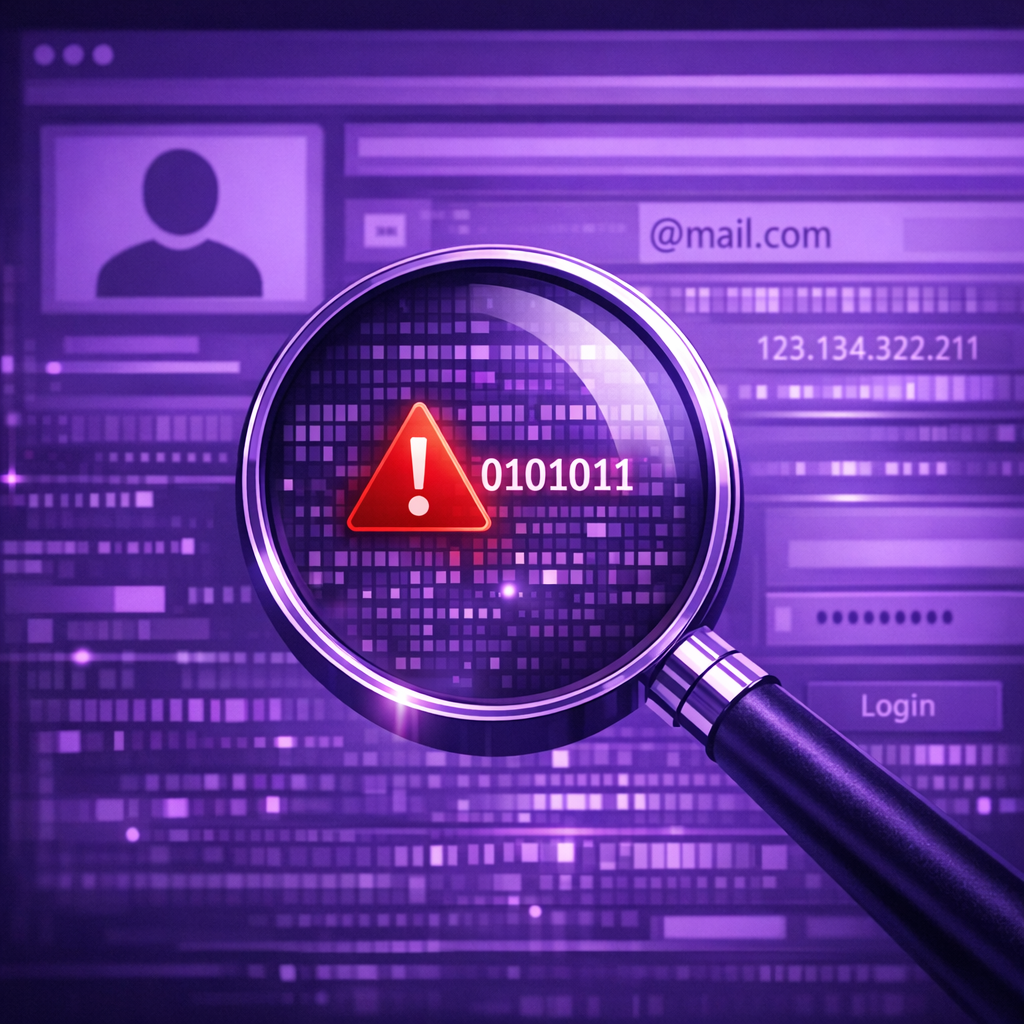
Modern fraudsters no longer break down doors; they enter with the right keys. Valid credentials, recognized devices, credible customer journeys: everything seems normal. And yet, something is wrong.
That something is weak signals.
What is a weak signal in digital identity?
A weak signal, as its name suggests, is not a red alert. It is a detail. A micro-anomaly. An almost invisible (or rather ignored) inconsistency taken in isolation, but which takes on its full meaning when correlated with other elements.
For example:
- a known device… but whose technical fingerprint has changed slightly;
- a connection from a usual city… at a completely atypical time;
- correct keystrokes… but with an unusual rhythm;
- a smooth user journey… but traveled at a speed too fast to be human.
None of these elements alone is sufficient to justify blocking an event. But together, they tell a different story from what the declarative data would suggest.
Why strong signals are no longer enough
Historically, security relied on binary elements: correct password, validated SMS code, recognized device.
The problem? These proofs can be stolen, intercepted, or simulated.
Malware, phishing, massive data leaks, and automation tools have turned credentials into mere raw material for fraudsters. Even strong authentication is no longer foolproof against real-time proxy attacks or remote takeover.
The result: a user can tick all the boxes for legitimacy while still being a fraudster. This is precisely where weak signals become decisive.
Weak signals reveal behavior, not a declared identity
A declared identity can be falsified. Behavior is much more difficult to fake.
Weak signals allow us to answer not the question “Is this information correct?” but “Does this behavior resemble that of a legitimate human being in this specific context?”
This leads us to a dynamic interpretation of digital identity, based on the consistency of habits, the continuity of interactions, and the logic of sequences of actions.
From isolated events to behavioral history
The true power of weak signals lies not in a snapshot, but in duration.
A strange connection may be insignificant. Two anomalies close together begin to raise questions. A series of micro-deviations paints a picture of fraud.
It is by connecting these dots that we move from one-off checks to continuous behavioral monitoring. Digital identity ceases to be a state and becomes an evolving probability.
The challenge: detecting without degrading the experience
Exploiting weak signals does not mean increasing friction.
The goal is to adapt the level of vigilance: request additional verification only when the risk increases, silently monitor suspicious behavior, and trigger enhanced controls on sensitive actions.
In other words: make security proportional to the actual risk.
When email addresses become a weak signal
Email addresses are often perceived as simple contact identifiers. However, they contain a wealth of information that is underestimated when analyzed from a semantic and behavioral perspective.
Let’s take two examples: marie.dupont@yahoo.fr and ma.rie_du.pont1567@gmail.com.
Both addresses are technically valid. Both can pass standard checks. But they don’t tell the same story.
Semantic analysis involves observing the structure, logic, and consistency of an email address in relation to the context declared by the user.
Discreet but telling clues may emerge: domain name, username composition, presence of promotional keywords, consistent or inconsistent series of numbers, unusual complexity, or recurrence of similar patterns observed in previous fraud cases.
Taken in isolation, none of these elements proves fraud. But they may indicate that an address was created quickly, en masse, or for purely transactional rather than relational purposes.
A real digital identity often leaves traces of continuity. Conversely, in many fraud scenarios, the email address is a disposable tool designed to pass a technical check, not to reflect a lasting identity.
Semantic analysis therefore allows us to answer a subtle question: does this address resemble a human point of contact or a functional artifact created for a specific scenario?
Once again, the value comes from correlation: unusually structured email, rapid account creation, device recently seen on other accounts, automated browsing. It is the aggregation of these weak signals that reveals a credible risk.
From raw data to contextual intelligence
Weak signals already exist in your systems: technical logs, browsing data, device metadata, action sequences.
The difference lies not in the quantity of data, but in the ability to correlate it in real time, contextualize it according to the journey, learn from past patterns, and detect subtle deviations.
Digital identity is no longer a file, it is a flow
For years, we treated identity as a file: static information to be verified once and for all.
Weak signals are forcing us to change our paradigm. Identity is becoming a continuous stream of behaviors, which are confirmed or degraded through interactions.
Conclusion
Major frauds rarely hide behind big anomalies. They are concealed in the details that we don’t look at.
Learning to read weak signals means accepting that the truth is no longer found in a single piece of evidence, but in the accumulation of micro-clues. In a world where identities can be fabricated, stolen, or rented, this subtle reading becomes one of the pillars of digital trust.



 Română
  English (UK)
  Français
  Español
  Italiano
  Nederlands
  Português